Why the Next Hit Might Come From a City You Can't Spell
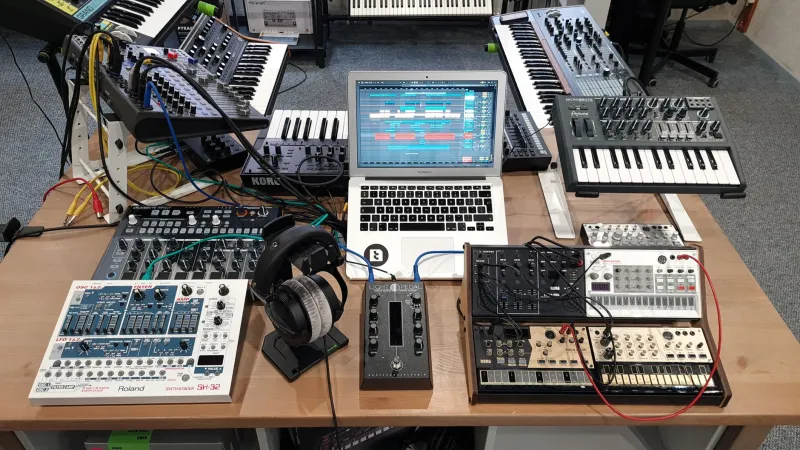
There's a producer in Bangkok who has never been to Los Angeles. He's never walked into a recording studio with a professional mixing board the size of a dining table, never had a label A&R in his ear about commercial potential, never paid $300 an hour for booth time. What he has is a laptop, a pair of mid-range headphones, a pirated copy of a DAW he eventually paid for when he started making real money, and an internet connection that's, honestly, better than what you'd find in most American apartments.
His beats have been streamed 40 million times. He has placements on records you've heard. And he has zero interest in moving to California.
The Studio Is Wherever You Are
The democratization of music production is a story that's been told in pieces for about 15 years — GarageBand, home recording, the bedroom producer mythology. But the version of that story that's playing out right now is different in scale and in geography.
The tools have gotten good enough, fast enough, and cheap enough that the quality gap between a professional facility in Burbank and a well-equipped home setup in São Paulo is now, in many genres, effectively zero. FL Studio, Ableton, Logic. A decent audio interface. A condenser mic. A subscription to a sample library. Total investment: under $2,000. Potential output: indistinguishable from major-label product to most listeners on most playback systems.
And crucially, the collaboration infrastructure has caught up with the production infrastructure. Remote session work, file sharing, async feedback loops, video mixing sessions — the workflows that used to require physical proximity have been replaced by workflows that require only bandwidth. A vocalist in Accra can record a topline over a beat from a producer in Warsaw, get notes from a mix engineer in Melbourne, and have a finished track ready for upload without any of them ever being in the same room.
The result is that geography — specifically, proximity to Los Angeles, New York, Nashville, or Atlanta — is losing its functional significance as a prerequisite for making competitive entertainment content.
Case Studies in Borderless Production
The evidence isn't theoretical. It's in the credits.
Afrobeats production, which has gone from a regional genre to a genuinely global commercial force, has been powered in significant part by producers working out of Lagos home studios. The sound that's now getting licensed for American commercials, sampled by US rappers, and charting on Billboard was developed without the involvement of a single American production hub. It came to America on its own terms.
In Southeast Asia, a loose network of producers operating across Bangkok, Kuala Lumpur, and Manila has been quietly building an infrastructure for what some are calling "tropical pop" — a production aesthetic that draws on regional musical traditions while meeting the sonics of international streaming. Tracks from this scene are landing on Spotify editorial playlists in Europe and North America with increasing regularity, often without any Western label involvement.
Brazilian phonk — a mutation of a Memphis rap subgenre that was itself already a niche — became a global TikTok phenomenon driven almost entirely by producers in São Paulo and Rio who discovered the original material through YouTube rabbit holes and rebuilt it in their own image. The genre's biggest moments in 2022 and 2023 were Brazilian exports wearing American vintage clothing. The irony is delicious.
What This Means for LA, Nashville, and New York
Let's be honest: the major American entertainment hubs aren't going anywhere. The infrastructure, the industry relationships, the institutional knowledge, the networking density — these things have real value that doesn't evaporate because a kid in Accra can make a great beat on a laptop.
But the monopoly is over.
What these cities are losing is the default. For most of the 20th century, if you wanted to make professional-grade music or film or television, you had to go to where the tools and the industry were. That was just physics. Now it isn't. And when the geographic default breaks down, the economic logic that depended on it starts to crack too.
Studio rental revenue. Session musician work. The entire support economy around physical production — all of it is under pressure from a model where the production happens wherever the creator happens to be. The cities that built their cultural economies around being the place are now competing with every place on earth that has decent internet.
'Made in America' in a Borderless Culture Economy
There's a version of this conversation that gets nationalistic in a hurry, and it's worth steering around that. The question of whether American cultural products should be made by Americans in America is less interesting than the question of what "American culture" even means when its biggest influences are increasingly international.
The more productive frame is economic: who captures value from this new production model, and how does that value flow? Right now, the platforms — Spotify, Apple Music, YouTube, TikTok — are the primary beneficiaries of borderless production because they get content from everywhere at scale without bearing the cost of creating it. Creators everywhere get a small slice. The intermediaries who used to extract rent from geographic bottlenecks — the studios, the labels, the real estate around them — get squeezed.
For individual creators in Accra or Bangkok, the new model is genuinely liberating. For the American entertainment industry as a structural entity, it's a slow renegotiation of terms that it didn't ask for and isn't entirely sure how to navigate.
The Map Is Being Redrawn in Real Time
The most honest thing you can say about the current moment is that nobody knows exactly where it lands. The geographic decentralization of entertainment production is real and accelerating, but the industry's gravitational centers haven't collapsed — they've just been joined by a lot more gravitational bodies.
What the next five years will determine is whether the new production hubs in West Africa, Southeast Asia, and South America can build the full-stack infrastructure — not just great content, but distribution relationships, sync licensing pipelines, and sustainable creator economies — that would make them genuine alternatives to the American model rather than just suppliers to it.
The tools are there. The talent is there. The internet is there.
Whether the map gets redrawn completely, or whether Los Angeles just learns to speak more languages, might be the most interesting question in entertainment right now.